

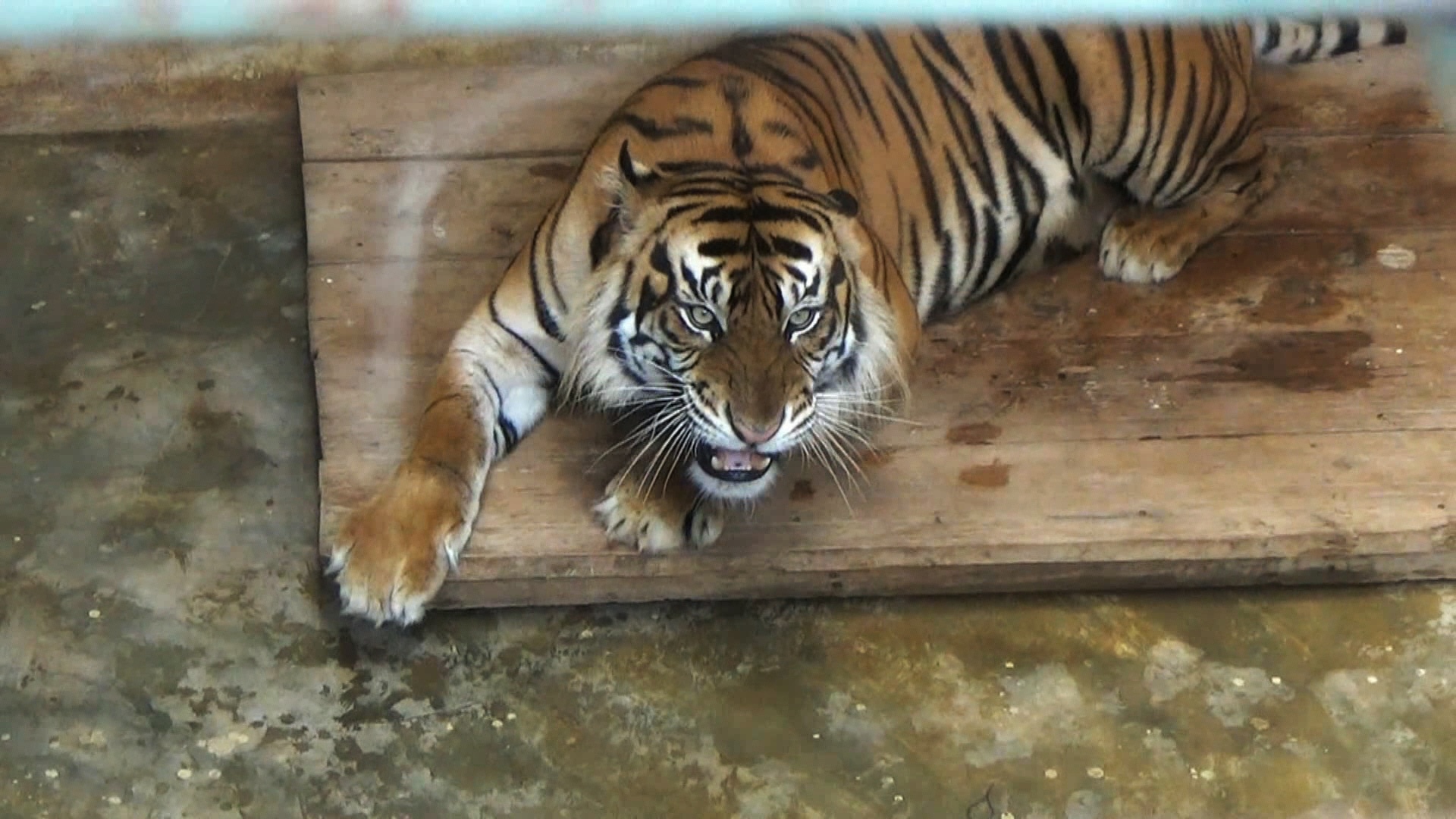
“Not every rescued tiger can return to the wild. But that does not mean their journey ends. Some begin a different mission—one that helps secure the future of their species in ways few could ever imagine. Monang was one of them.”
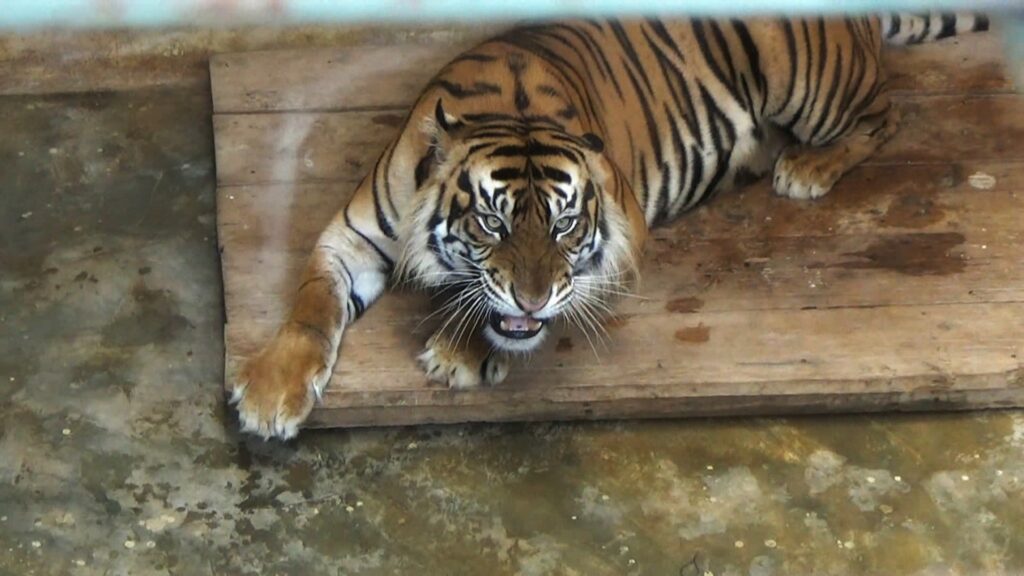
[Monang, Harimau Sumatera]
In 2017, a male Sumatran tiger (Panthera tigris sumatrae) was found near Parmonangan Village in Simalungun Regency, North Sumatra, Indonesia. He was in critical condition. One of his legs had been severely injured after becoming trapped in an illegal wire snare.
At first glance, a snare appears deceptively simple, a loop of steel cable hidden along a wildlife trail. Yet for a tiger, it can alter the course of an entire life.
Every attempt to break free only tightens the wire. Wounds deepen. Tissue is damaged. Infection sets in. Many wild animals ultimately die from exhaustion, starvation, severe infection, or the loss of a limb that once allowed them to hunt and survive.
Monang was fortunate. He was found before it was too late.
A rescue team evacuated him and rushed him into intensive veterinary care. Months of treatment eventually healed the physical injury to his leg.
But not every wound can truly heal.
The medical intervention saved Monang’s life, but it could not restore his chance of returning to the wild.
In wildlife conservation, the decision to release a tiger is never based solely on whether its injuries have healed. More importantly, conservationists must determine whether the animal can survive independently. A tiger must be capable of hunting efficiently, defending its territory, avoiding conflicts with other tigers, and adapting to the constant challenges of a natural ecosystem.
After extensive assessments, Monang was determined to no longer have a sufficient chance of surviving safely in the wild. From that moment on, his journey home came to an end.
Monang never lost his wild instincts. He simply lost the opportunity to prove them again in the forest.
Monang was transferred to Barumun Nagari Wildlife Sanctuary, where he became part of a long-term conservation program for Sumatran tigers. No wildlife sanctuary is ever intended to replace the forest.
Sanctuaries exist as places of recovery—temporary spaces where injured or displaced wild animals can regain the strength and natural behaviours they need before returning to their rightful home.
For some individuals, however, that return is no longer possible. Monang became one of them.
Not because people wanted him to remain under human care, but because conservation also carries the responsibility of recognizing when releasing an individual would place its life at unacceptable risk.
Yet Monang’s story did not end behind the sanctuary’s fences. He continued to live as a tiger.
His natural instincts were carefully maintained. Human interaction was kept to an absolute minimum. Every aspect of his care was designed to preserve the behaviours that define a wild tiger, even though he would never roam free again.
At Barumun, Monang found a different purpose. He was no longer a tiger preparing to return to the forest. Instead, he became an individual whose life would help shape the future of his species.
At the sanctuary, Monang was paired with Gadis, a female Sumatran tiger that had also been rescued after conflict with humans made her return to the wild impossible. Their pairing was never simply about bringing two rescued tigers together.
It was part of a carefully planned conservation breeding programme designed to help safeguard one of the world’s most critically endangered tiger subspecies.
Hope arrived in December 2018. Monang and Gadis became the parents of two cubs: Citra Kartini and Surya Manggala. Their birth marked an important milestone—not only for Barumun Nagari Wildlife Sanctuary, but also for Sumatran tiger conservation in Indonesia.
For Monang, the opportunity to return to the forest would never come again. Through his offspring, however, hope found another way.
For more than three years, Citra Kartini and Surya Manggala underwent rehabilitation at Barumun. Their hunting instincts were nurtured, human contact was carefully restricted, and every stage of their development was designed to prepare them for life in the wild.
In June 2022, both young tigers were released into Kerinci Seblat National Park, one of the last strongholds of the Sumatran tiger.
Their lives in the wild were tragically shorter than anyone had hoped.
Yet their journey provided invaluable lessons that continue to strengthen scientific understanding, improve post-release monitoring, and refine conservation strategies for future tiger reintroductions.
And that journey began with Monang.
It is easy to see Monang simply as a tiger that never had the chance to return to the wild. But his story is far greater than that.
Conservation success cannot always be measured by the number of animals released back into their natural habitats. Some individuals leave their greatest contribution without ever setting foot in the forest again.
Monang was one of them. Through his life, a new generation was born.
Through the journey of his offspring, conservation practitioners gained valuable insights into rehabilitation, soft-release strategies, and post-release monitoring. Through his story, the public came to understand that a single snare does far more than injure one tiger.
It can alter the future of an individual, affect the survival of an already fragile population, and serve as a powerful reminder of why protecting the remaining forests of Sumatra is more urgent than ever. Monang’s story also reminds us that conservation is not defined only by successful releases.
It is equally defined by the lessons learned from every individual entrusted to our care. Every rescued tiger expands our understanding. Every challenge strengthens future conservation efforts. Every life matters.
On 11 August 2025, Monang’s journey came to an end.
His passing was deeply felt by the keepers, veterinarians, field technicians, researchers, and everyone who had witnessed the remarkable resilience of a tiger that survived an illegal snare and went on to play an extraordinary role in conservation. Yet, as is often true in conservation, the end of one life does not mark the end of its purpose.
Monang’s legacy lives on.
It lives in every tiger now undergoing rehabilitation with the hope of one day returning to the wild. It lives in every effort to remove snares from Sumatran forests before they claim another victim. It lives in every lesson that continues to improve rehabilitation, release protocols, and long-term conservation strategies.
Although Monang never returned to the rainforest he once called home, he and Gadis left behind a new generation that became an important chapter in Indonesia’s ongoing efforts to conserve the Sumatran tiger.
More importantly, Monang left something even more enduring than descendants. He left knowledge. He left experience. He left a deeper understanding that every rescued tiger has value—even when returning to the wild is no longer possible.
Ultimately, Monang’s legacy is not measured by whether he ever made it back to the forest.
It is measured by every lesson his life inspired, every second chance made possible because of what conservationists learned from his journey, and every step taken to ensure that Sumatra’s remaining forests continue to provide a safe home for its tigers.
Monang never returned to the forest.
But through the life he lived, he helped ensure that there will always be tigers with a chance to return home.

Article supported by:
The Wildlife Whisperer of Sumatra | #EXTINCTIONISNOTANOPTION