

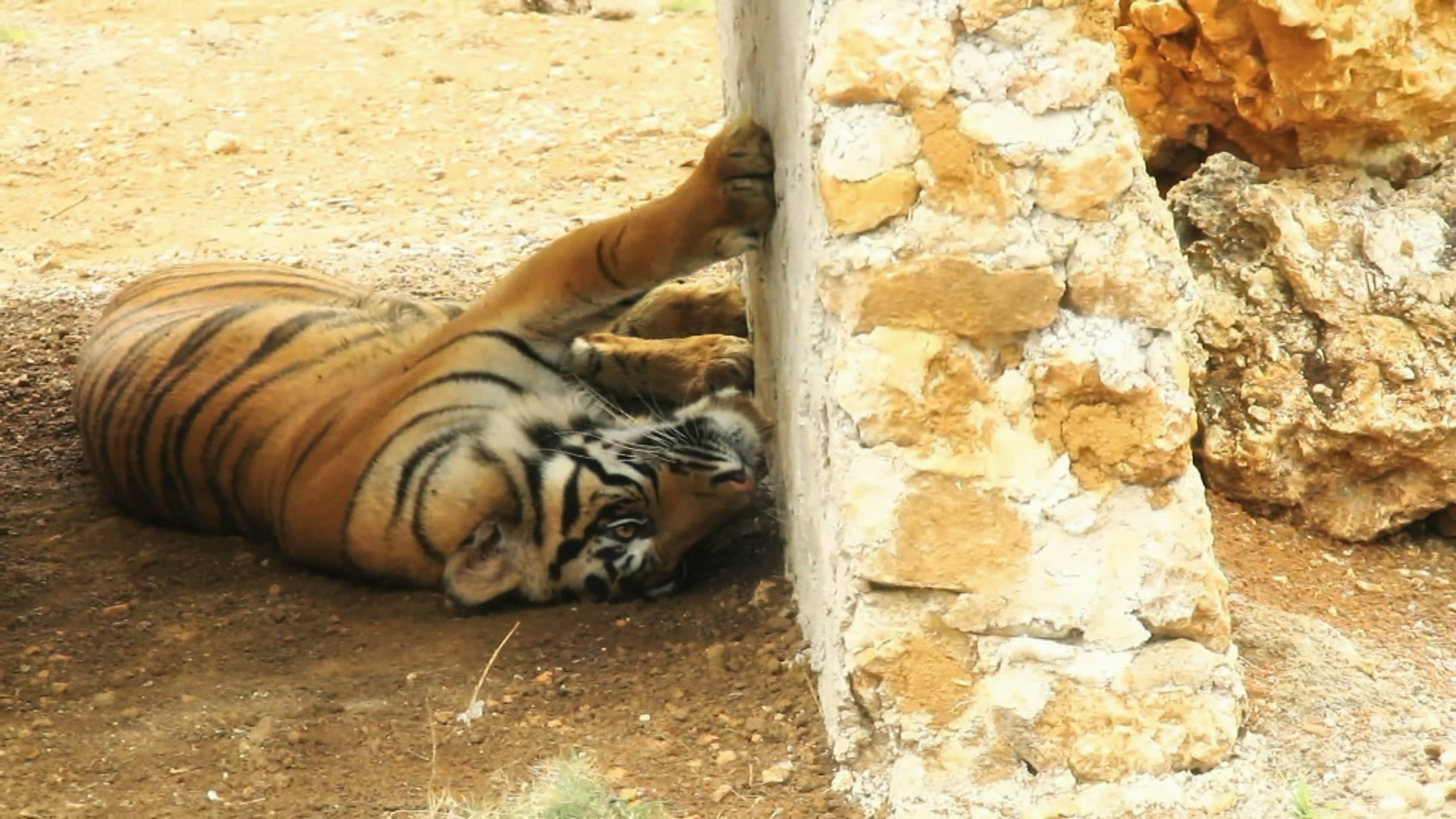
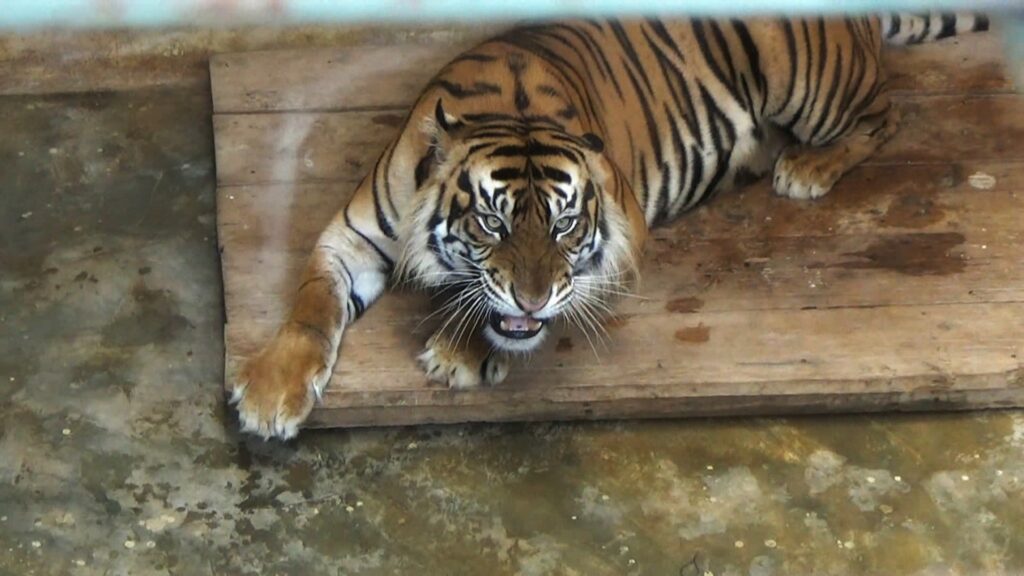
In Batu Nanggar Village, Batang Onang District, North Padang Lawas Regency, North Sumatra, lies the Barumun Sumatran Tiger Sanctuary, a facility established to care for Sumatran tigers (Panthera tigris sumatrae) requiring rescue, veterinary care, rehabilitation, or longer-term management.
The sanctuary is situated within a landscape connected to the Barumun Wildlife Sanctuary. In its 2016 account of the facility’s establishment, the Directorate General of Conservation of Natural Resources and Ecosystem (KSDAE) noted that the sanctuary was designed with a direct connection to the natural habitat of the Barumun Wildlife Sanctuary.
Since its establishment, Barumun has housed tigers with different histories. Some were born in the wild and brought to the sanctuary following rescue operations. Others were born at the sanctuary. Several have subsequently been released into natural habitat, while others remain under care.
According to Barumun’s internal management records, 18 individual Sumatran tigers have been recorded in the sanctuary’s history since 2016.
The Barumun Sumatran Tiger Sanctuary was established through Decree of the Director General of Conservation of Natural Resources and Ecosystem No. SK.373/KSDAE/SET.29/2016, dated 30 September 2016, concerning the designation of a Sumatran Tiger Sanctuary in Batu Nanggar Village, Batang Onang District, North Padang Lawas Regency, North Sumatra.
The sanctuary was formally inaugurated on 23 November 2016. According to the Directorate General of KSDAE, its development and design involved the Ministry of Environment and Forestry together with several parties, including the Centre for Forest and Environmental Engineering, the Directorate General of KSDAE, and the Barumun Consortium.
A 2018 publication by the Directorate General of KSDAE described Barumun Nagari Wildlife Sanctuary as a facility established for the rescue, rehabilitation, and breeding of Sumatran tigers, within the broader context of species conservation.
This description reflects the stated purpose of the sanctuary at the time and should be understood within the historical context in which the facility was established.
Not every tiger arriving at Barumun has the same history. Some are wild-born animals rescued following encounters with people or after being found caught in snares. Others require veterinary care, rehabilitation, or observation before a decision can be made about their longer-term management.
Gadis is one of the earliest tigers associated with the sanctuary. She was rescued in 2016 after being caught in a snare in Batang Gadis National Park. The resulting injury led to the amputation of her right foreleg.
Monang, a male tiger brought to Barumun in 2017, was also rescued after being caught in a snare in Parmonangan Village, Simalungun Regency.
Gadis and Monang later became the parents of several tigers born at Barumun. Their histories also illustrate an important aspect of wildlife rescue: the circumstances and condition of each animal can differ considerably. Some individuals sustain permanent injuries; some undergo rehabilitation before being considered for release; others remain under human care.
According to Barumun’s internal management records for 2026, 18 individual Sumatran tigers have been recorded as part of the sanctuary’s management history since 2016.
Of these, 11 were F0, or wild-born individuals, while 7 were F1 individuals born at Barumun.
Their recorded histories include:
These figures represent the overall history of individual tigers handled by the sanctuary. They should therefore not be interpreted as mutually exclusive categories across time. An individual that was released and subsequently died remains part of the sanctuary’s historical record.
The 18 individuals include Gadis, Monang, Surya Manggala, Citra Kartini, Sri Nabilla, Raja Suro, Dewi Siundol, Adeva, Bisma, Albanta, Besti, Ambar Goldsmith, Beru Situtung, Tonga, Senja, Nunuk, Ninik, and Aprilia.
Each entered Barumun under different circumstances and followed a different management pathway.
Gadis and Monang occupy a distinctive place in Barumun’s history. Both were wild-born tigers rescued from the field and later became the parents of several tigers born at the sanctuary. Their first recorded offspring were Surya Manggala and Citra Kartini, born on 8 December 2018. Both subsequently underwent preparation for release and were returned to natural habitat in 2022.
In January 2022, Gadis and Monang produced three more offspring: Adeva, Bisma, and Albanta. The three cubs were subsequently monitored at Barumun. In January 2025, Nunuk and Ninik were born at the sanctuary. Internal Barumun records identify them as offspring of Gadis and Monang.
The lineage of these animals forms an important part of Barumun’s history, linking rescued wild-born individuals with a second generation born under human care.
For a tiger undergoing rehabilitation, release into the wild is one possible management outcome, but it depends on the condition of the individual and the assessment undertaken before a release decision is made.
On 8 June 2022, Surya Manggala and Citra Kartini were released into the core zone of Kerinci Seblat National Park after approximately three and a half years at Barumun.
Before release, both underwent health assessments and other preparations, including the fitting of GPS collars to support post-release monitoring. The decision to release the two tigers was also linked to the need to avoid inbreeding, as both were offspring of the same parents. Their subsequent histories, however, were not identical.
Citra Kartini was found dead in the forest on 19 July 2022, approximately six weeks after her release. Her movements had been monitored through her GPS collar, and field teams had conducted monitoring and mitigation activities following reports of tiger activity in areas near local communities.
Her case illustrates an important point in wildlife reintroduction: the process does not end when an animal is released. Post-release monitoring can provide critical information about the animal’s movements, adaptation, interactions, and survival.
The tigers that have passed through Barumun have originated from several parts of Sumatra. Sri Nabilla, an F0 female, was rescued from the Tapus Sipagimbal area of South Tapanuli before being released into Gunung Leuser National Park.
Raja Suro, another wild-born tiger, originated from Aceh Singkil. He underwent rehabilitation at Barumun before being released into Gunung Leuser National Park. Other individuals, including Besti, Ambar Goldsmith, and Beru Situtung, also underwent rehabilitation at Barumun before release.
In March 2024, Ambar Goldsmith and Beru Situtung were released into the core zone of the Lubuk Tanggok forest block within Gunung Leuser National Park. Prior to release, the destination area underwent habitat suitability assessment, and both tigers were fitted with GPS collars to support post-release monitoring.
Aprilia followed a different pathway. She originated from Pelalawan, Riau, and was transferred from the Riau Natural Resources Conservation Agency (BBKSDA Riau) to North Sumatra in March 2025 following a rescue operation associated with interaction with local communities. According to the North Sumatra BBKSDA, Aprilia was subsequently placed at Barumun for health monitoring and rehabilitation.
Taken together, these cases show that Barumun has received tigers from several regions of Sumatra, rather than exclusively from the surrounding North Sumatran landscape.
Not every individual that has entered Barumun has survived. One such case was Dewi Siundol, a wild-born female rescued in December 2021 following conflict with communities in Sosopan District, North Padang Lawas. At the time of rescue, she was found in poor physical condition and had injuries in several parts of her body.
Dewi remained under care at Barumun for almost six months. Although her condition initially improved, it later deteriorated. She died on 19 March 2023, after which a necropsy was conducted.
Her case illustrates why rescue should not automatically be equated with release. The condition of an animal at the time of rescue, the extent of its injuries, and its subsequent health trajectory can all influence what happens next.
Another death occurred after release. Citra Kartini died in the wild after being released into Kerinci Seblat National Park.
These two cases are different in both circumstances and timing. One occurred during the period of care at the sanctuary; the other occurred after the animal had returned to natural habitat. For that reason, mortality figures are best understood alongside the individual histories behind them.
According to Barumun’s internal management records for 2026, six Sumatran tigers are currently housed at the sanctuary: Gadis, Bisma, Albanta, Nunuk, Ninik, and Aprilia.
Gadis is the remaining wild-born female from the original breeding pair. Bisma and Albanta are offspring of Gadis and Monang, born in 2022, while Nunuk and Ninik were born in 2025. Aprilia is a wild-born tiger from Pelalawan, Riau, transferred to Barumun from BBKSDA Riau in 2025.
Together, these six animals represent different stages in the sanctuary’s history: wild-born tigers rescued from the field, tigers born under human care, and an individual transferred from another conservation authority following rescue.
Almost a decade after its establishment, Barumun’s records reflect a range of conservation interventions and outcomes. Some tigers arrived following rescue operations and remained under care. Others underwent rehabilitation before being returned to their natural habitat. Some were born at the sanctuary and later released. Others died during their time under care or after release.
For this reason, the figure of 18 individuals is better understood as a record of individual histories than as a single measure of the success or failure of a sanctuary. Behind each number is a different set of circumstances: where the tiger came from, why it was rescued, its condition upon arrival, how long it remained at the sanctuary, and what happened afterwards.
Documenting these histories provides a more complete picture of the realities of Sumatran tiger conservation. Rescue does not necessarily lead to release, and release does not necessarily lead to survival. Each tiger follows its own trajectory, shaped by its history, condition, and the circumstances surrounding its management.
Barumun’s history offers one window into that process from rescue and care to rehabilitation, release, and post-release monitoring and provides a basis for asking broader questions about how rescued Sumatran tigers are assessed, managed, and, where appropriate, returned to the wild.
Government and publicly available sources