

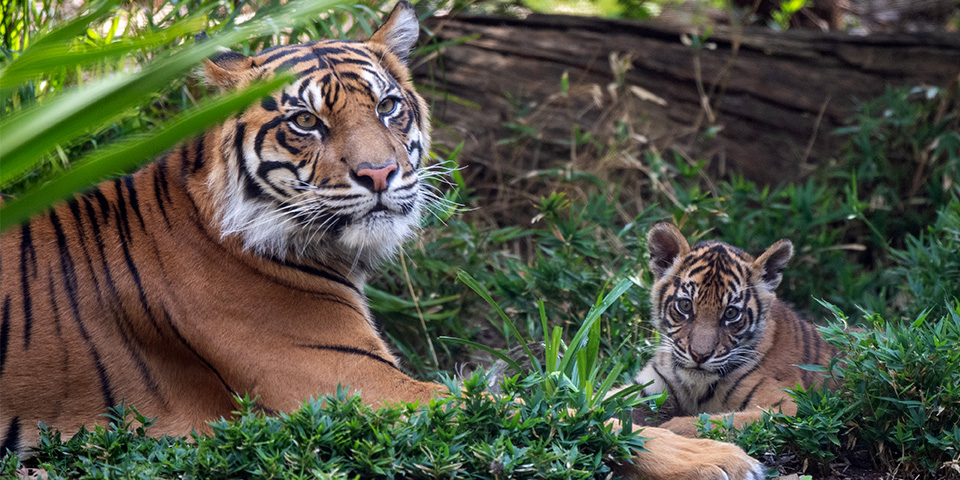
A story of a lost home, a stolen freedom, and the hope of returning to where they truly belong.
“No tiger is born to live behind fences. No tiger chooses to leave its forest. When a tiger is found wandering through farmland, caught in a snare at the edge of the forest, or forced to spend the rest of its life in a sanctuary, what we are witnessing is rarely the result of a tiger’s choice. More often, it is the consequence of profound changes to the place it once called home.”
Across Sumatra, reports of Sumatran Tigers entering plantations, approaching human settlements, preying on livestock, or becoming trapped in snares continue to emerge. Too often, these incidents lead people to view tigers as threats that must be removed or controlled.
But what if we tried to see these events from the tiger’s perspective?
What if, one day, every road you had known suddenly became a wall? What if the place where you were born and raised slowly disappeared? What if food became increasingly difficult to find while the space available for you to live grew smaller with each passing year?
For the Sumatran Tiger, this is not a hypothetical scenario. It is a reality.
For humans, home is a place of comfort, security, and belonging. For a tiger, the forest is far more than a home. It is a hunting ground. A nursery. A refuge. A territory. A place to find a mate. A landscape that supports every stage of its life.
A Sumatran Tiger requires vast expanses of habitat to survive. In a healthy ecosystem, an individual may roam across tens or even hundreds of square kilometers in search of prey and to maintain its territory.
Within the forest, a tiger knows every trail it follows. It knows where water can be found. It understands the movements of its prey. It recognizes the sounds of the forest that have surrounded it since birth.
When that forest is destroyed or fragmented, a tiger loses more than physical space. It loses the ecological system that has shaped its existence for thousands of years.
One of the greatest misconceptions surrounding human-tiger conflict is the belief that tigers are entering human territory. In many cases, the opposite is true. Humans have transformed landscapes that were once tiger habitat.
Forests are cleared for agriculture and plantations. Roads cut through wildlife corridors. Areas that once served as natural pathways for wildlife become settlements, mines, or industrial developments. As a result, habitats that were once connected become fragmented into isolated patches.
To people, these changes may appear to be signs of development. To a tiger, they may represent the loss of hunting grounds, restricted access to water, and the disappearance of ecological corridors that once allowed movement across the landscape.
As prey populations decline and available habitat shrinks, tigers often have few options. They travel farther. They venture into unfamiliar areas.
And sometimes, those journeys bring them dangerously close to people.
Among the many threats facing Sumatran Tigers, snares remain one of the most devastating. Many snares are not specifically intended for tigers. They may be set for wild boar or other animals. Yet in the forest, a snare does not discriminate.
When a tiger steps into a wire snare, the steel cable tightens with every movement it makes. The more the animal struggles to escape, the deeper the injury becomes. In many cases, these wounds lead to severe infections, extensive tissue damage, and even the loss of a limb due to interrupted blood circulation.
Some tigers are discovered after being trapped for days. Some are rescued. Others are never found alive. For an apex predator that depends on strength, speed, and hunting ability, the loss of a leg is more than a physical injury.
It can mean the loss of its ability to survive in the wild.
When an injured tiger is rescued, many people assume the problem has been solved. For the tiger, however, the most difficult part of the journey may only be beginning. Tigers that suffer severe injuries often lose the ability to survive independently in the wild.
They may no longer be capable of hunting effectively. They may be unable to defend a territory. They may become vulnerable to conflict with other tigers. Under such circumstances, some individuals must spend the remainder of their lives in sanctuaries or wildlife rehabilitation facilities.
From a human perspective, a sanctuary is a place of protection. And indeed, it is. Sanctuaries provide food, veterinary care, safety, and a second chance at life that these animals might otherwise never have received.
Yet it is important to remember one fundamental truth: A sanctuary is not a forest.
Tigers are wild animals. Their bodies, instincts, and behaviors have evolved over millennia to function in free-ranging landscapes. Even in the best-managed sanctuaries, certain aspects of a tiger’s natural life can never be fully replaced.
A wild tiger chooses where it will walk. It decides when to hunt. It determines which territory it will defend. Every day in the wild presents new challenges, new scents, new encounters, and new opportunities to express natural behaviors. Within an enclosure, some of those freedoms inevitably disappear.
This is why keepers and animal care teams work tirelessly to provide environmental enrichment designed to support the physical and psychological well-being of tigers living under human care. Scent trails, enrichment balls, hidden food items, exploration opportunities, and activities that stimulate hunting instincts all play an important role in improving welfare.
Yet no enrichment program, no matter how thoughtfully designed, can truly replace an entire forest.
For some tigers, rehabilitation offers hope. If their physical condition allows, if their natural behaviors remain intact, and if suitable habitat is available, reintroduction to the wild may become a possibility.
However, releasing a tiger back into nature is a complex and demanding process. The animal must be capable of hunting independently. It must avoid human settlements. It must adapt to environmental challenges. And most importantly, there must still be a forest capable of supporting its survival.
This is why tiger conservation can never be limited to rescuing individual animals. We must also protect the landscapes they depend upon. Because there is no place to return to if home no longer exists.
When people see a Sumatran Tiger in a sanctuary, they often see a success story. And in many ways, it is. A rescued tiger represents a life saved. But there is another story hidden beneath that success.
Behind every tiger living in a sanctuary, there is often a story of habitat loss. A story of fragmented wildlife corridors. A story of snares that were never removed. A story of unresolved conflict. A story of shrinking space and diminishing opportunities for survival in the wild.
Sanctuaries serve as a final refuge for individuals that can no longer survive in nature. But sanctuaries were never meant to become the future of all Sumatran Tigers. Their future belongs in the forest.
Today, the Sumatran Tiger (Panthera tigris sumatrae) is the last surviving tiger subspecies in Indonesia. It is the final guardian of Sumatra’s forests. Yet its survival cannot depend solely on human compassion.
Tigers need intact forests. They need healthy prey populations. They need connected wildlife corridors. They need protection from snares and poaching. And above all, they need the space to remain what they have always been: wild tigers.
Because the ultimate goal of conservation is not to place more tigers behind fences. The goal is to ensure that fewer tigers are ever forced to leave their forests. No tiger chooses to live in captivity. No tiger chooses to lose its home. And no tiger chooses to abandon the forest that has shaped its existence since birth.
If we truly wish to save the Sumatran Tiger, we must save more than the animal itself. We must protect its forests, its migration routes, its prey, and the ecosystems that allow it to live freely and fulfill its ecological role. Because for a tiger, freedom is not a luxury.

Article supported by: